
Kathy Lohrum Cotton won first place in the 2017 Book Spine Poems contest sponsored by the Carbondale, Illinois, Public Library, with this poem, “The Subject Tonight Is Love.”
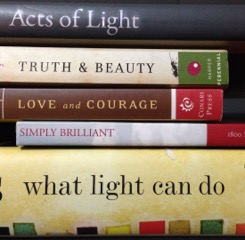
Cotton also authored this poem, “Acts of Light,” which was
published in the newsletter of the Illinois State Poetry Society, which she
edits.
Cotton issued a call for members of the society to submit their own Book Spine Poems. I decided to take up the challenge. Since haiku is traditionally untitled, I used a book entitled Haiku to identify the genre of my offering, which was published in the ISPS newsletter.
Cotton issued a call for members of the society to submit their own Book Spine Poems. I decided to take up the challenge. Since haiku is traditionally untitled, I used a book entitled Haiku to identify the genre of my offering, which was published in the ISPS newsletter.

To “write” a Book Spine Poem, you need a camera of some kind
(I used an iPad to photograph mine). If you have good photo software, you can
trim yours better than my haiku (my photo software crashed). You may use books
you own, or go to a library where you have a bigger choice of titles to choose
from.
If you aren’t into photography, you can integrate book titles
into a poem. For several days, I slept in a guest room that evidently doubled as a family
library. I wrote the following prose poem which includes the names of 50 books,
49 of which are mysteries (The Girl
Sleuth is a book about mysteries, not itself a mystery). Forty-nine of the
books were on the shelves in the guest room. I had to throw in a Nancy Drew
book, since that series got me interested in reading mysteries. I now suspect
that it would be a better poem if I cut a few of the titles out!
After Reading Too Many Mysteries
It’s a hard
truth we learn from wild horses at Deception Point, where we found blood from
the stone near the twisted root. On the Day of the Dead, we decide to solve the
murder at the Pottawatomi light, but have to deal with doctored evidence, hush
money, road rage, birds of prey, the kiss of the bees, desert heat and even the
girl with the dragon tattoo. We have much night work in a darker place. While
other people sleep, we will listen to the silence; we shall not sleep. Children
of the storm, we will follow the track of the cat, an endangered species. If
the girl sleuth, whom we presumed innocent, is with child, we will face a
firestorm; drive to the last precinct; learn if it was truly death in a tenured
position and whether it was an acceptable loss. At dead midnight, we will enter
locked rooms, turn seven dials, seek the secret of the old clock, check the
arrangement of cards on the table. A flashback will give us total recall of all
our yesterdays, including a cinnamon kiss, the falcon at the portal, and a dead
madonna. We will develop a taste for death and leave with exit wounds.
~ Wilda
Morris
This poem was
published in Voices on the Wind (http://voicesonthewind.net/),
November, 2013.
Bio:
Kathy Lohrum Cotton is a southern Illinois poet and digital
collage artist whose work appears in literary journals, anthologies, and
poetry/art exhibits. She is the author of two chapbooks and the
illustrated poetry collection, Deluxe Box of Crayons. Cotton serves
on the boards of the Illinois State Poetry Society and National Federation of
State Poetry Societies and is editor for three annual NFSPS poetry books.
The August Challenge:
The August Challenge is to submit a book title poem. It may
be a Book Spine Poem or a “regular” poem with several book titles integrated
into it.
Title your poem unless it is a form that does not use
titles. If you use a form, please identify the form when you submit your poem.
Unless you are submitting a Book Spine Poem, single-space and don’t use lines
that are overly long (because the blog format doesn’t accommodate long lines).
You may submit a published poem if you retain copyright, but please include publication data. This
applies to poems published in books, journals, newspapers, or on the Internet.
The deadline is August 15. Poems
submitted after the deadline will not be considered. There is no charge to
enter, so there are no monetary rewards; however winners are published on this
blog. Please don’t stray too far from “family-friendly” language. No
simultaneous submissions, please. You should know by the end of the month
whether or not your poem will be published on this blog. Decision of the judge
or judges is final.
Copyright on each poem is retained by the poet. If a
previously unpublished poem wins and is published elsewhere later, please give
credit to this blog.
How to Submit Your Poem:
Send one poem only to wildamorris[at]ameritech[dot]net (substitute the @ sign for “at” and a . for “dot”). Put “August Poetry Challenge Submission” in the subject line of your email. Include a brief bio which can be printed with your poem if you are a winner this month. Please put your name and bio under the poem in your email.
Send one poem only to wildamorris[at]ameritech[dot]net (substitute the @ sign for “at” and a . for “dot”). Put “August Poetry Challenge Submission” in the subject line of your email. Include a brief bio which can be printed with your poem if you are a winner this month. Please put your name and bio under the poem in your email.
Book Spine Poems are to be submitted as jpeg files.
Submission of a poem gives permission for the poem to be
posted on the blog if it is a winner, so
be sure that you put your name (exactly as you would like it to appear if you
do win) at the end of the poem, or
for a photo submission, in the email.
Book Spine Poems should be submitted as jpeg files.
If you submit a poem integrating the names of books into the
poem, please add a note providing the titles of the books you used and
identifying their authors. Word poems may be pasted into an email or sent as an
attachment (no pdf files, please). Please
do not indent the poem or center it on the page. It helps if you submit the poem in the format used on the blog
(Title and poem left-justified; title in bold (not all in capital letters);
your name at the bottom of the poem). Also, please do not use multiple spaces
instead of commas in the middle of lines. I have no problem with poets using
that technique (I sometimes do it myself). However I have difficulty getting
the blog to accept and maintain extra spaces.
Please do not indent or center your poem on the page, put it in a box or against a special background.
Please do not indent or center your poem on the page, put it in a box or against a special background.
Poems shorter than 40 lines are generally preferred but
longer poems will be considered.
© Wilda Morris


