Saturday, April 22, 2023

Poems that Hook

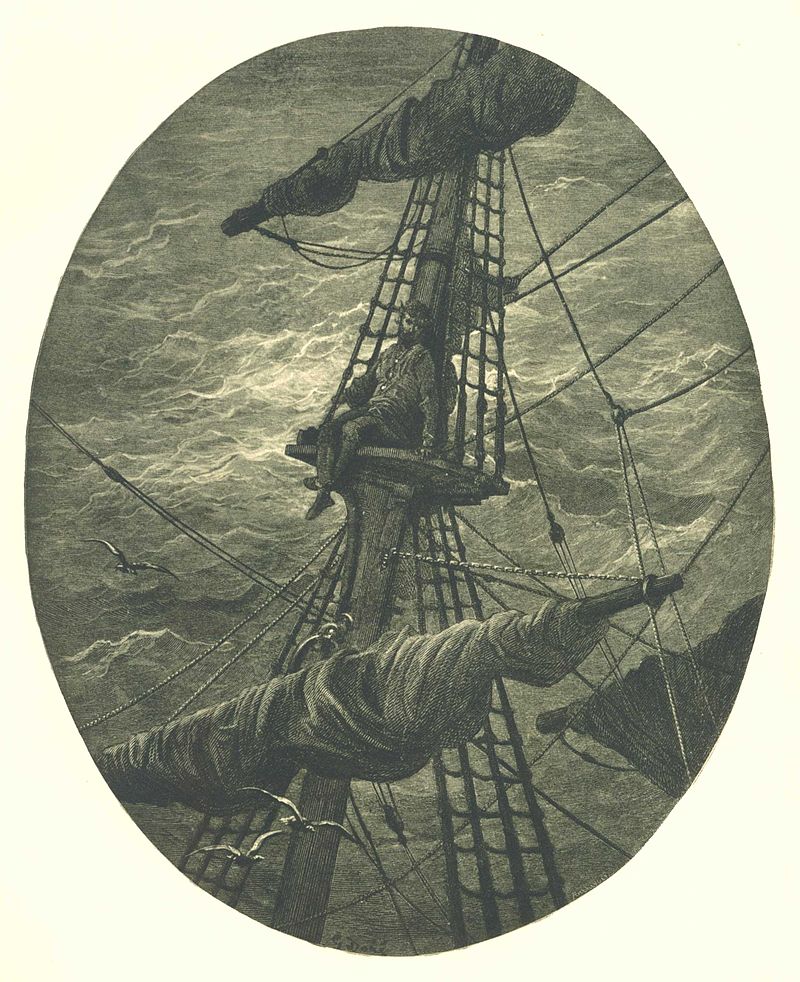
Der Alte Matrose b 01.jpg

The Ancient Mariner by Gustave Dore
in the public domain


Sometimes it is a particular poem that draws a child—or youth or adult--into the world of poetry. It grabs the reader’s attention, sparks imagination, pulls at the heart or mind and they are hooked. Something about the narrative, or the cadence, or the musicality of the poem speaks to them and they are changed in some way. They become avid readers—and sometimes writers—of poetry. Here are two accounts of such experiences.

A Tale of Penance

A 1797 British poem did what no other poem could do for me. I was a sophomore at Los Angeles High School and only slightly open to poetic expressions, but when Mrs. Edwards assigned Samuel Taylor Coleridge’s The Rime of the Ancient Mariner, little did she know what lasting influence it would have on my life. This narrative poem starts simply with a sailor returning from a long sea voyage who stops a guest on his way to a wedding in order to tell him a tale, which the listener cannot tear himself away from. The tale is at once a confession, a psychological study, penance, and a warning.

As a sophomore I hadn’t thought too deeply about these matters. Looking back, I see how many life lessons I gained while reading this. I couldn’t go at the slow pace of the nightly assigned pages which limited us, so I gulped down the entire poem in one night. The poem grabbed me by the throat and squeezed so hard it made me bleed so many emotions and empathy over the pages and into my heart. As the sailor was forced to tell his tale over and over, I became his advocate, doing the same for the poem itself.

The content alone took hold of me, but along with it, I learned the techniques of personification, repetition, rhyme, alliteration, building suspense, and inviting the reader to suspend disbelief, techniques I still use.

When others ask me to tell them my origin story, I warn them they are about to become my “wedding guest.” I still talk about getting “rid of the albatross around my neck,” and at every opportunity I quote the lines:

“Day after day, day after day,
We stuck, nor breath nor motion;
As idle as a painted ship
Upon a painted ocean.

Water, water, every where,
nd the boards did shrink;
Water, water, every where,
Nor any drop to drink.”

This poetic experience taught me how to keep my readers’ attention and imbue feelings into my poetry. Having been a teacher myself, I am aware that I may never know the influence of something I taught on my students.

My last time in a bookstore, I found an illustrated copy of the poem and bought it for my granddaughters, but then found I couldn’t part with it and kept it for myself.

~ Evie Groch

About this piece, Groch says, “Research shows that things we learn in the first twenty years of our lives, our most impressionable years, carry their influence over us forever. Of course we can change, but a foundation is laid on which we build and the values we hold dear. After having done research on the generations and their unique profiles, I find this to be more and more true. Many things I learned early on in life still serve me well today, like the lessons I took away from an assignment from Mrs. Edwards.”


Tyson West records his experience with a poem that was one of my favorites as a child. Groch says she often quotes words from “The Rime of the Ancient Mariner.” I have often quoted a few lines of “Little Orphant Annie” (sometimes spelled “Little Orphan Annie” as well as Henry Wadsworth’s poem, “The Children’s Hour.”


From Project Gutenberg

If You Don’t Watch Out

My old home town wedged in the last Appalachian wrinkle
before land leveled west to the Hoosier State
a good Ohio away
left empty my longing for a tornado to twist my boredom to Oz.
Save dread of atom bomb fallout
we slept safe from Jets rumbling Sharks, hurricanes, and heroin.
I ambled through A Child's Garden of Verse
to learn only God can make a tree,
until on the first day of April,
alone, alone, seated on a large flat stone
in tween hunger green among Jell-O salad,
Appian Way pizza, and all
the Disney I could dream
Little Orphant Annie came to stay.
She cleaned my rhyme and meter up,
and shooed the boredom off the porch,
then opened wide my wardrobe’s portal
pulling me deep into poesy’s carnivorous blossom
where two great big Black Things snatched me,
charmed, and cursed my foolish and forever dance.
Annie lost her parents’ love while I spun
with the planet of my clan’s private mythos
orbiting the black hole of mom
and dad’s immigrant never enough.
Though teachers baked sports
as red, white, and blue American pie
I never clutzed the gridiron or B ball court
let alone reached rarified
STATE WRESTLING CHAMPION.
Still mom and dad pardoned
my passion for patterning sounds
—
after all I huddled at home studying and they could see
my eyes followed the shape of girls.
Annie addicted my soft soul to the needle of verse—
yes, she and her goblins got me
and taught there were other rhythms for me
and a story sails true only
through the way its words are trimmed.

~ Tyson West

Did you know that James Whitcomb Riley first published “Little Orphant Annie” in the Indianapolis Journal, under tit title, “The Elf Child”? According to Wikipedia,  Riley changed the title to “Little Orphant Allie.” Allie was the nickname of Mary Alice Smith, an orphan who lived and worked in the Riley household while James was a child. The poem later inspired the comic strip, “Little Orphan Annie,” and the Broadway musical, as well as several movies and other spin-offs.


What brought you to your love of poetry? A poem? A poet? A teacher or mentor? A member of your family? It is not too late to submit your story (in prose or poetry or a combination of both). Just go back to the guidelines posted April 1.


Bios: 

Evie Groch’s opinion pieces, humor, poems, short stories, word challenges, and other articles have been widely published in the New York Times, The San Francisco Chronicle, The Contra Costa Times, Games Magazine, anthologies, and many online venues. Her short stories, poems, and memoir pieces have won her recognition and awards. erTravel, language, and immigration are special themes for her work.

Tyson West has published speculative fiction and poetry in free verse, form verse and haiku distilled from his mystical relationship with noxious weeds and magpies in Eastern Washington. He has no plans to quit his day job in real estate. He was the featured USA poet at Muse Pie Press from December 2019 through December 2022. 


Tuesday, April 18, 2023

Family Members Nurturing a Love of Poetry

Ruth Ann Thrun

The three poems in today’s post all say family members nourished their love of poetry. First, a poet from Wisconsin, where hunting is part of the culture, pays tribute to his sister.


Anymore, it’s not about shooting a deer

 She was Ruthie to me.  My big sister, my hero.
She was Miss Thrun to her high school students, 
making “History” relevant, changing young lives.
She showed them how to look at things, how to
analyze and prioritize …her own eyes always quick
not only to instill The Fear of God in them, but also
how to show kindness and love.  To empathize.

She was already gone…  Complications, they said,
of uterine cancer diagnosed too late.  “A blessing,” the
doctor added.  A pulmonary clot during a transfusion.

Sixteen years later, I posthumously accepted, on
Ruthie’s behalf, an Honored Faculty Award under the
halftime lights at a high school homecoming game.
This at UNC’s Lab High School in Greeley, CO.
Her former students then were adults, and her fellow
educators were all retired.  Yet, each spoke as if they’d
just discussed national politics with her …only yesterday.
My eyes welled again from emotions I’d so long buried. 

We brought her back to Wisconsin -- my mother, my
twin sister and I.  Ruthie rests now at Hope Cemetery,
hardly a mile from where I still hunt whitetails.  And, I tell
her again, each fall, how sorry I am that I never told her
how much I really loved her, nor how thankful I was for the
paperback of Robert Frost’s Poems, she gave me that
Christmas when I was 14 …that’s made all the difference.

 ~ Thomas A. Thrun


Binod Dawadi, a Nepali poet, credits his love for poetry to his father. He says to his father, "I can't give you anything," while he is giving his father praise. He is also honoring his father by continuing the tradition of reading and writing.

My Father – My Inspiration to Be a Poet 

My father couldn't read above tenth grade level.
He was bullied and hated by friends
So he couldn't get a higher position job.
He worked as a government officer in small post.
In his free time, he read Mahabharata and Ramayana,
Sometimes Gita. He used to spend all his time
reading. He also wrote short stories,
Autobiography and poems.
He told me, You should read more and write more
To you share your knowledge

To the world, and you will obtain more knowledge.
I used to listen him reading and watch him writing.
From my childhood, I knew that reading and writing
can make us great, so I read literature and wrote poems.
These, along with my father's motivation and inspiration
Made me fall in love with poetry,

My father left me and my family
when I was just 11 years old,
But I remember his words and I see him
in a dream for forever,

I can't give you anything, my father,
Sita Ram Dawadi, but today I praise you
and make you immortal through my poetry.
Today you are is inside my soul guiding me
To think and imagine and to be a writer.

~ Binod Dawadi

Dawadi added these words of tribute: “My father was my hero. He taught me good cultures. He always read and wrote in his free time. He also motivated me to read and write. So from his good habits I learned to read and write at home as well as school. So I became a writer. My father physically left us more than 20 years ago, but his spirit is connected to mine and makes me a creative writer with imagination. Thank you so much my father. You will be immortal.”


Finally, a poet from Massachusetts pays tribute to her creative aunt:

Marvelous Peggy 

Born forty years premature,
our aunt stacked her poetic meanderings
on cob-webbed shelves in her mind, 

dusting off her masterpieces
at intimate family gatherings, “holy roller” meetings,
(her words, not mine), cherished private readings   

of her remarkable rhyming revelations,
contentious political skewerings,
and late-in-life religious epiphanies. 

Out of her imagination
flowed discerning, humorous, pointed
interpretations of the world and those within it.  

Poetry − her lifeline for unloading heavy burdens,
livening up a party, boisterously airing her views
Oh Democracy, where art thou? she’d cry. 

Intimidated by technology of any variety,
she never actualized sharing opportunities
cyberspace affords fellow writers and poets. 

On her death I uncovered her treasure;
poems scribbled on scraps of paper,
in old notebooks, the back of greeting cards. 

a legacy to be shared with family members,
brothers, sisters, nieces, nephews,
scattered across the country;   

drawing together related strangers
through common literary history and interest,
forever reuniting this Girl Scout with that hitchhiker, 

who was the very picture of her glamorous aunt,
from her literary prowess, to her luxurious fingernails;
sister-cousins, rejoined by the closing of a door. 

~ Elaine Sorrentino

 Here is "Marvelous Peggy" herself:


These poets retain copyright on their own poems


Coming up next: poems that hooked their readers, followed by tributes to poetry mentors, and poets who hooked their readers. Submissions sometimes overlap these categories, of course. Thrum’s poem above would fit into the category of poets who hooked their readers as well as the category of family members nurturing the love of poetry.


Bios:

Binod Dawadi, Kathmandu, Nepal, the author of The Power of Words, has a master's degree in English. He has worked on more than 1000 anthologies published in various renowned magazines. His vision is to change society through knowledge, so he wants to provide enlightenment to the people through his writing skills.

Elaine Sorrentino has been published in Minerva Rising, Willawaw Journal, Glass: A Journal of Poetry, Ekphrastic Review, Writing in a Women’s Voice, Global Poemic, ONE ART: a journal of poetry, Agape Review, Haiku Universe, Sparks of Calliope, Muddy River Poetry Review, Your Daily Poem,  Panoplyzine, Etched Onyx Magazine, and at wildamorris.blogspot.com.  She was featured on a poetry podcast at Onyx Publications. 

Thomas A. Thrun, retired in Oconomowoc, WI, cites his life-long interest in writing especially to his Wisconsin farming heritage and to Robert Frost’s poetry.  Thrun’s father was an oral teller of farming stories – on the church steps after Sunday services and places like the local feed mill and grocery store -- to anyone who’d listen, with each story, like one of Frost’s poems, usually ending in a simple truth.  Hence, inspiring Thrun’s own narrative, poetic style.  A former weekly newspaper editor in Wisconsin and Washington State, Thrun earned his undergraduate degree in English/Journalism from the University of Wisconsin-Platteville and has been published in a number of state and national anthologies. He now dotes on his own, two young grand boys.