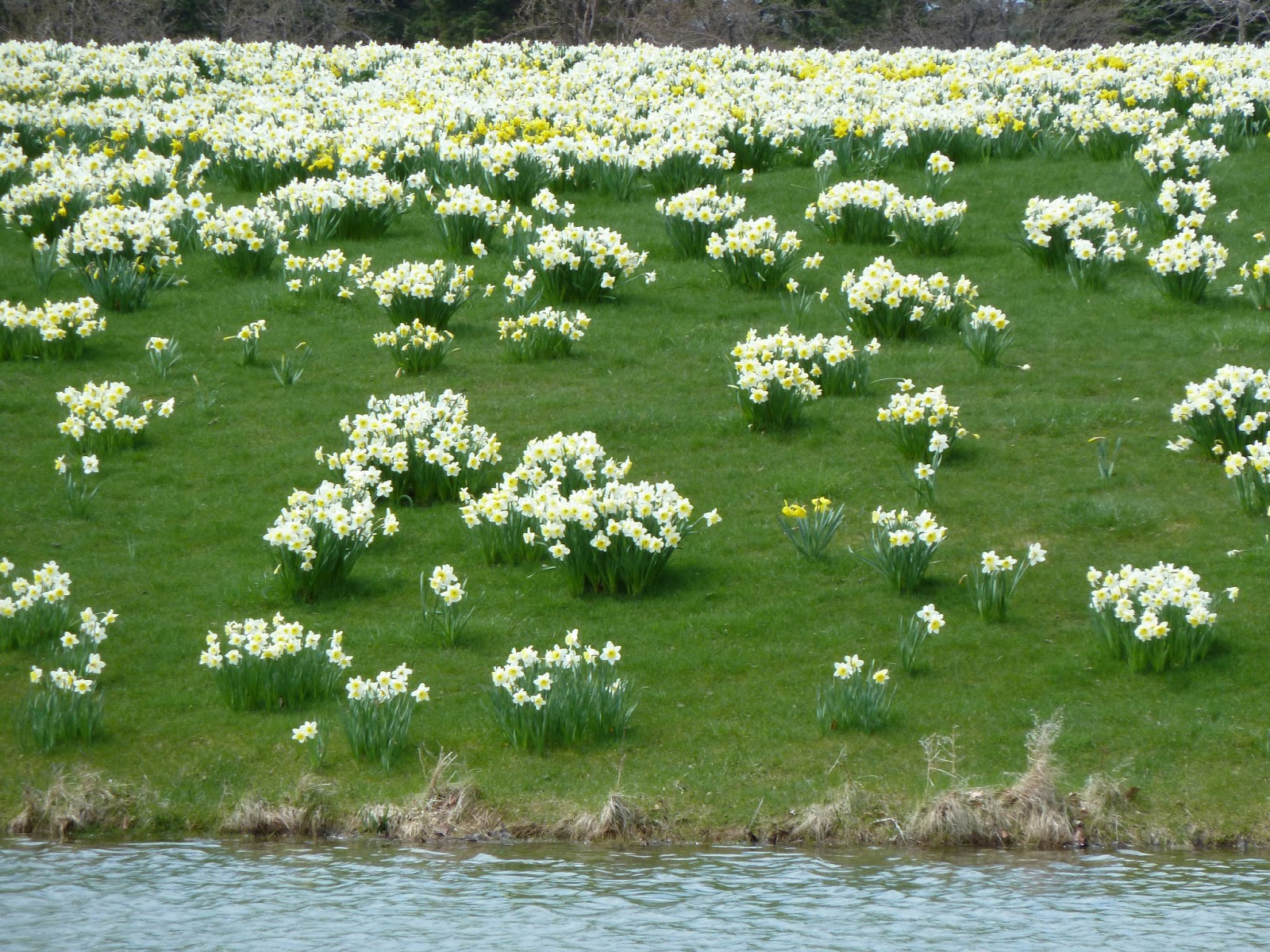
Photo by Gail E. Goepfert
The Daffodils
I wandered lonely as
a cloud
That floats on high o'er vales and hills,
When all at once I saw a crowd,
A host, of golden daffodils;
Beside the lake, beneath the trees,
Fluttering and dancing in the breeze.
Continuous as the stars that shine
And twinkle on the Milky Way,
They stretched in never-ending line
Along the margin of a bay:
Ten thousand saw I at a glance,
Tossing their heads in sprightly dance.
The waves beside them danced, but they
Out-did the sparkling waves in glee:
A Poet could not but be gay,
In such a jocund company:
I gazed—and gazed—but little thought
What wealth the show to me had brought:
For oft, when on my couch I lie
In vacant or in pensive mood,
They flash upon that inward eye
Which is the bliss of solitude;
And then my heart with pleasure fills,
And dances with the daffodils.
That floats on high o'er vales and hills,
When all at once I saw a crowd,
A host, of golden daffodils;
Beside the lake, beneath the trees,
Fluttering and dancing in the breeze.
Continuous as the stars that shine
And twinkle on the Milky Way,
They stretched in never-ending line
Along the margin of a bay:
Ten thousand saw I at a glance,
Tossing their heads in sprightly dance.
The waves beside them danced, but they
Out-did the sparkling waves in glee:
A Poet could not but be gay,
In such a jocund company:
I gazed—and gazed—but little thought
What wealth the show to me had brought:
For oft, when on my couch I lie
In vacant or in pensive mood,
They flash upon that inward eye
Which is the bliss of solitude;
And then my heart with pleasure fills,
And dances with the daffodils.
~ William Wordsworth
I have loved this
poem since I first heard it read. Perhaps you feel the same way. “Daffodils” is one of the most famous and best loved
poems in the English language.
Wordsworth’s poetic
art is evident. He begins with a simile: “I wandered lonely as a cloud.” The
idea of a cloud being lonely is personification, but the simile might be said
to be the opposite—the human speaker is like an object of nature. Later in the
poem, the daffodils outdo the waves in “glee”—a statement that personifies both
flowers and the water.
Another interesting
aspect of the poem is that, while the speaker is like a cloud in the sky in
stanza one, the daffodils are like stars in the sky in the second stanza. Stanza two was not in the first draft, which you can read at https://wordsworth.org.uk/daffodils.html.
The water is
mentioned in each of the first three stanzas (“lake” in stanza 1; “bay” in
stanza 2; “waves” in stanza 3). That the water is absent from the final stanza
is symbolic of the superior contribution of the flowers—it is the daffodils
that come forcefully to mind later.
If the first draft,
the color of the daffodils (“golden”) was not mentioned. It adds a lot to the
visual effect of the poem. What seems to have had the greatest impact on the
poet, in addition to the vast number of daffodils encountered, is their
movement. Note that each stanza includes a form of the word “dance.” This word
provides a more intensely pleasant mood to the poem than if Wordsworth had just said the
daffodils “swayed” in the breeze.
Wordsworth has used
poetic license in saying he “wandered lonely as a cloud,” at least if scholars
are correct in thinking the poem, written in 1804, was inspired by a walk he
took two years earlier with his sister Dorothy. You can read Dorothy’s journal
entry here:
“Daffodils” is a
formal poem, as you doubtless noticed, with regular iambic meter and six-line
stanzas. The rhyme scheme is ABABCC.
A century or so
later, Helen Hunt Jackson, wrote a poem about an experience while she
was visiting Italy:
Poppies in the
Wheat
Along Ancona's hills the shimmering heat,
A tropic tide of air with ebb and flow
Bathes all the fields of wheat until they glow
Like flashing seas of green, which toss and beat
Around the vines. The poppies lithe and fleet
Seem running, fiery torchmen, to and fro
To mark the shore.
The farmer does not know
That they are there. He walks with heavy feet,
Counting the bread and wine by autumn's gain,
But I,--I smile to think that days remain
Perhaps to me in which, though bread be sweet
No more, and red wine warm my blood in vain,
I shall be glad remembering how the fleet,
Lithe poppies ran like torchmen with the wheat.
~ Helen Hunt Jackson
This is, I think, an excellent poem,
though not as good as Wordsworth’s. “Poppies on the Wheat” is a sonnet with the
rhyme scheme ABBAABBACCACAA.
Jackson repeats the simile of poppies
running like torchmen. The narrator of the poem believes the farmer is
interested in the value of his wheat (and grapes) and is inattentive to the
beauty of the flowers. She, on the other hand, is putting those poppies in her
memory bank so she can enjoy them even after she has lost the ability to enjoy
bread and wine.
While Wordsworth suggests that he did
not fully value the daffodil dance when he saw it, he came to recognize how
much it enriched his life because of his flashbacks to that experience. In
Jackson’s poem, on the other hand, the speaker is enjoying the beauty of the
flowers and already anticipating that they will come to mind again and again.
The theme of recollection appeals to
me because I have experienced it. I remember driving in Illinois and “seeing”
from the corner of my eye against a pink sunset the pyramid at Sakara. The sky
looked just like the sky behind that pyramid as my tour bus some months earlier
had driven past. Momentarily I was transported back to Egypt, as the pyramid flashed
on my “inward eye.”
Note:The poems above are both in the public domain.
JULY
2012 CHALLENGE
The challenge for July is to write a
poem about remembering something you have seen, and how it impacts you later.
It may an experience with nature, as in Wordsworth’s and Jackson’s poems. Or it
may be something more like the pyramid at Sakara. For purposes of this
challenge, write about a “thing” and not about remembering a person.
Your poem can be free verse or
formal. If formal, please specify the form. Poems of 40 or fewer lines are
preferred. Due to formatting difficulties, please submit poems that can be left
justified and that do not have indentations or spaces in the middle of lines.
Please submit only one poem during
any particular month.
The deadline is July 15. Poems
submitted after the July 15 deadline will not be considered.
Copyright on poems are retained by
the poets.
Poems published in books or on the Internet
(including Facebook and other on-line social networks) are not eligible. If you
poem has been published in a periodical, you may submit it if you retain
copyright, but please include publication data.
How
to Submit Your Poem:
Send your poem to wildamorris[at]ameritech[dot]net (substitute the @ sign for“at” and a . for [dot]. Be sure provide your e-mail address. When you submit your poem, add a note indicating where you took poetic license with the facts of your life (as Wordsworth evidently did). The poem should be in first person, as if it actually happened to the speaker in the poem. Submission of a poem gives permission for the poem to be posted on the blog if it is a winner, so be sure that you put your name, exactly as you would like it to appear if you do win, at the end of the poem. Poems may be pasted into an email or sent as an attachment. Please do not indent the poem or center it on the page.
© 2013 Wilda Morris
Send your poem to wildamorris[at]ameritech[dot]net (substitute the @ sign for“at” and a . for [dot]. Be sure provide your e-mail address. When you submit your poem, add a note indicating where you took poetic license with the facts of your life (as Wordsworth evidently did). The poem should be in first person, as if it actually happened to the speaker in the poem. Submission of a poem gives permission for the poem to be posted on the blog if it is a winner, so be sure that you put your name, exactly as you would like it to appear if you do win, at the end of the poem. Poems may be pasted into an email or sent as an attachment. Please do not indent the poem or center it on the page.
© 2013 Wilda Morris


